
In most labs, compliance issues don’t start with something obvious.
There’s no single moment where everything breaks.
It’s usually quieter than that.
A missing signature that gets overlooked.
A procedure that hasn’t been updated.
Documentation that lives in two places instead of one.
Individually, none of it feels urgent. Together, it adds up faster than most teams realize.
And by the time it shows up, it’s no longer a small issue.
The Problem Isn’t Big Mistakes
Most labs assume compliance risk would be easy to spot.
That’s rarely what inspectors find.
More often, it’s a pattern of small inconsistencies:
• A policy that doesn’t match current practice
• Training records that aren’t fully documented
• Logs that are complete — but not consistently maintained
These aren’t obvious problems. They’re subtle ones.
But subtle problems are harder to catch internally because they don’t interrupt the day. Work keeps moving. Patients are still being seen. Tests are still being run.
So, the assumption becomes: everything is fine.
Until someone looks closely.
Small Gaps Don’t Stay Small
The risk with minor compliance issues isn’t just that they exist — It’s that they compound.
One missing piece of documentation leads to another.
One outdated file gets copied forward.
One workaround becomes standard practice.
Over time, the system breaks down.
Small gaps turn into inconsistency.
Inconsistency becomes exposure.
And exposure shows up all at once — usually when it matters most.
Not because the lab wasn’t trying to stay compliant, but because the system wasn’t built to prevent it.
Why They’re Easy to Miss
Most labs aren’t ignoring compliance. They’re managing it the best way they can with the tools they have.
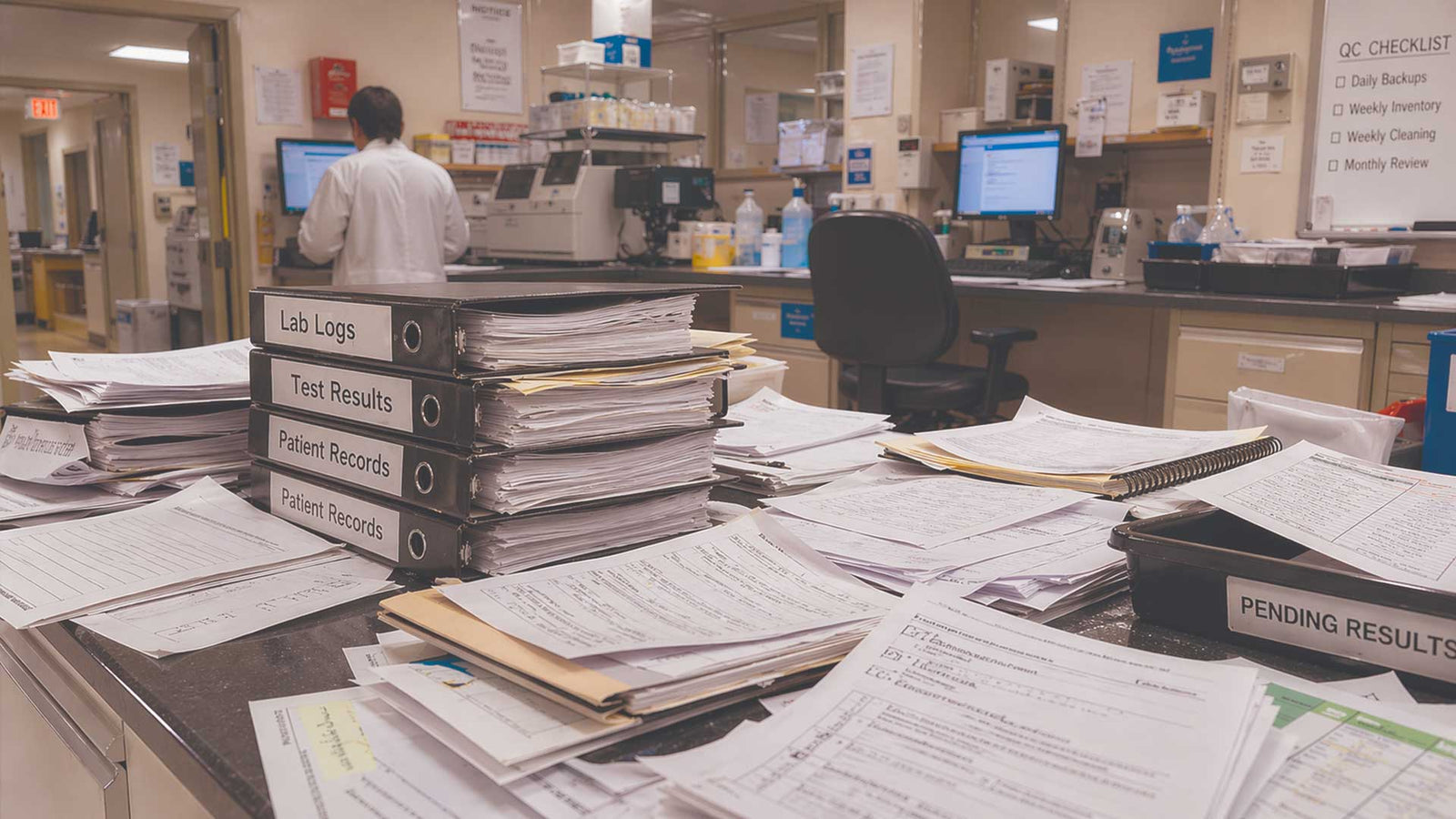
But when compliance is handled through paper files, shared drives, or a mix of both, visibility becomes limited.
You can’t easily see:
• What’s been completed
• What’s missing
• What’s outdated
• What’s inconsistent
Instead, you rely on memory, habit, and periodic checks.
And that’s where small gaps hide.
Not because anyone is careless — but because the system doesn’t make those gaps obvious.
The Difference Is Structure
The labs that stay ahead of compliance issues aren’t necessarily doing more work.
They’re working within a system that makes the work visible.
Documentation is centralized.
Processes are consistent.
Updates are controlled and trackable.
So, when something is missing, it shows up.
When something is outdated, it’s clear.
When something changes, it’s reflected everywhere it needs to be.
That’s what prevents small issues from turning into larger ones.
Not more effort — more structure.
Control Changes the Outcome
Compliance doesn’t break overnight.
It shifts gradually, in ways that are easy to overlook when everything else is moving quickly.
The difference between a smooth inspection and a stressful one often comes down to whether those small shifts were visible along the way — or discovered all at once.
MyInspection® gives labs a clear, structured way to manage compliance — keeping documentation accurate, current, and accessible without the burden of paper-based systems.
Because the goal isn’t just to fix problems when they appear.
It’s to make sure they don’t build in the first place.
How MyInspection® Fits Your Lab
MyInspection® gives your lab a more structured way to manage CLIA compliance—bringing documentation, processes, and oversight into one clear, centralized system.
Designed with real-world lab experience behind it, it reflects how compliance is actually managed day to day. The result is greater visibility, stronger consistency, and a more confident approach to compliance — every day, not just at inspection time.
To learn more about how MyInspection® software can revolutionize your lab compliance™, please contact us for an informative software demonstration.
Schedule a FREE demonstration.






Leave a comment (all fields required)